
Why Some Jewelry Feels Comfortable And Others Don’t
The Hidden Science Of Everyday Comfort
Why Some Jewelry Feels Comfortable And Others Don’t
The Hidden Science Of Everyday Comfort
Most people have experienced this when choosing everyday jewelry.
You buy a new piece.
It looks great.
The size seems right.
The design feels perfect.
Yet after wearing it for a while, something feels off.
Perhaps the skin becomes irritated.
Perhaps the jewelry feels uncomfortable after several hours.
Perhaps you simply find yourself wearing it less and less.
At the same time, another piece can be worn every day without a second thought.
Why does this happen?
Why do some pieces feel natural to wear while others never quite do?
The answer is rarely a single factor.
Long-term comfort is influenced by materials, design, surface finishing, fit, and the way jewelry interacts with daily life.
Understanding these factors helps explain why two pieces that look similar can create completely different wearing experiences.
Comfort Is More Than Appearance
When people evaluate jewelry, appearance usually comes first.
Comfort is often considered later.
Yet comfort is one of the strongest predictors of whether a piece becomes part of everyday life.
A ring may look beautiful but feel bulky.
A bracelet may appear elegant but catch on clothing repeatedly.
An earring may seem lightweight yet become noticeable after several hours of wear.
These details rarely appear in product photographs.
But they often determine whether jewelry stays in regular rotation or ends up forgotten in a drawer.
The pieces people wear most are usually the pieces that create the least friction.
Both physically and mentally.
When comfort disappears from conscious attention, jewelry becomes easier to live with.
And pieces that are easy to live with tend to stay longer.
Why Materials Matter
Material influences much more than appearance.
It affects:
• Weight
• Durability
• Corrosion resistance
• Skin compatibility
• Long-term wear experience
This is one reason materials such as titanium and 316L stainless steel have become widely used in everyday jewelry.
Both offer excellent resistance to moisture and daily wear.
Both are durable enough for long-term use.
Yet they create different wearing experiences.
Titanium is significantly lighter.
316L stainless steel feels more substantial.
Part of this difference comes from density.
Titanium has a density of approximately 4.5 g/cm³, while 316L stainless steel is approximately 8.0 g/cm³.
In practical terms, a titanium ring of the same size may weigh nearly half as much as its stainless steel counterpart.
This difference becomes particularly noticeable in larger rings, bracelets, and earrings worn for long periods.
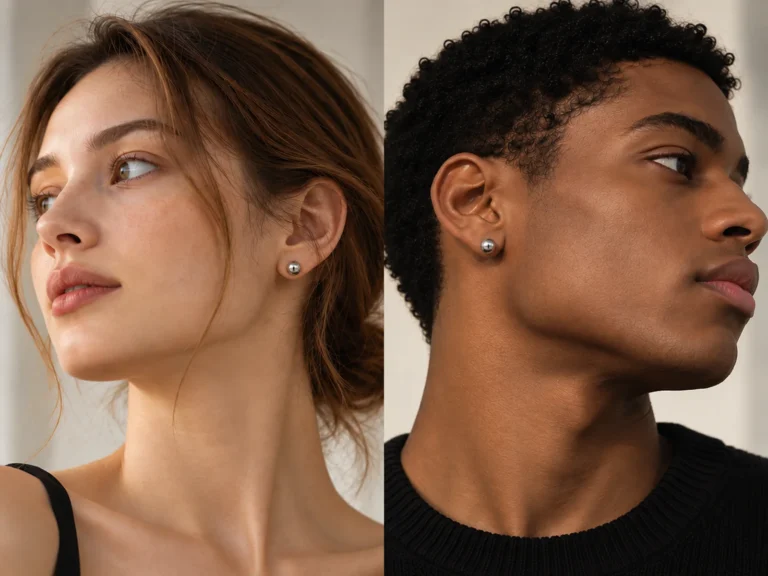
For example, reducing weight can help minimize the downward pull on the earlobe, which is one reason lightweight materials are often preferred for everyday earrings.
Some people appreciate the barely-there feeling of titanium.
Others prefer the reassuring weight of stainless steel.
Neither material is universally better.
The better choice depends on personal preference and intended use.
Good jewelry begins with selecting a material that supports the experience the wearer wants.

Why Skin Reactions Are Not Always Allergies
When irritation occurs, many people immediately assume they are allergic to metal.
Sometimes that is true.
Often it is more complicated.
Skin discomfort can result from several different factors:
• Friction
• Pressure
• Moisture buildup
• Surface roughness
• Sensitivity to specific alloying elements
• Residue from cosmetics or personal care products
Moisture is a particularly overlooked factor.
When sweat or water remains trapped between jewelry and skin, the outer layer of the skin can become softer and more vulnerable to irritation.
Moisture can also increase friction during movement, especially during exercise or in hot and humid environments.
Combined with constant contact, even well-made jewelry may become uncomfortable.
This distinction matters because irritation and allergy are not always the same thing.
A piece may cause discomfort without triggering an actual allergic response.
Understanding the cause is often the first step toward solving the problem.
Why Fresh Piercings Require Different Materials
One important factor is the condition of the skin itself.
A healed piercing and a fresh piercing are very different environments.
A healed piercing has already developed stable tissue.
A fresh piercing is still recovering and remains more vulnerable to irritation.
This is why professional piercers commonly recommend implant-grade titanium during the healing process.
The goal is not aesthetics.
The goal is stability, biocompatibility, and minimizing unnecessary stress while the body heals.
Titanium naturally forms a thin layer of titanium dioxide (TiO₂) when exposed to air.
This invisible protective layer is extremely stable and helps isolate the underlying metal from the surrounding environment.
As a result, titanium releases very few metal ions during normal wear, contributing to its reputation for excellent skin compatibility.
This is one reason implant-grade titanium is widely used in medical implants and professional piercing jewelry.
Once healing is complete, many people can comfortably wear a much wider range of materials.
The same jewelry may perform very differently depending on when it is worn.
Why Design Influences Comfort As Much As Material
Material is only part of the story.
Design matters just as much.
Consider two rings made from the same metal.
One may feel comfortable all day.
The other may not.
The difference often comes from factors such as:
• Width
• Thickness
• Edge profile
• Internal curvature
• Weight distribution
Many comfort-focused rings use a rounded inner profile, often referred to as a comfort fit design.
By removing sharp internal transitions and distributing pressure more evenly across the finger, this shape can feel noticeably more comfortable during long periods of wear.
The effect may seem small when first trying on a ring.
Over an entire day, the difference can become surprisingly noticeable.
A wider ring spreads pressure across a larger area of the finger.
A rounded inner surface can reduce pressure points.
Even small differences in geometry can change how a piece feels after hours of wear.
The same principle applies to earrings, bracelets, and necklaces.
Small differences in shape can dramatically change long-term comfort.
Many of the best design decisions go unnoticed.
Not because they are unimportant.
But because they work so naturally.
Why Surface Finishing Changes The Wearing Experience
Surface finishing affects more than appearance.
It also influences how jewelry feels against the skin and how it ages over time.
A highly polished surface feels smooth and reflective.
A brushed finish creates a softer visual character and often hides minor scratches more effectively.
A matte finish reduces reflections and creates a quieter appearance.
Different finishes can also affect how easily oils, fingerprints, and everyday wear become visible.
This is one reason two pieces made from the same material can age very differently.
The material may be identical.
The surface treatment may not be.
These differences may seem subtle at first.
But over months and years, they contribute significantly to the overall ownership experience.
Why Fit Is Often Overlooked
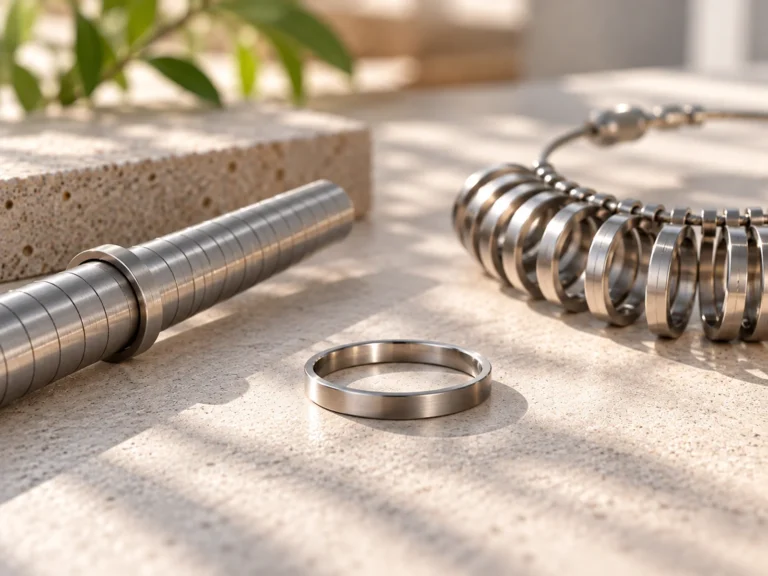
Even well-designed jewelry can feel uncomfortable if the fit is wrong.
A ring that is slightly too tight may create pressure throughout the day.
A bracelet that is too loose may move excessively.
An earring that hangs at the wrong angle may feel heavier than it actually is.
Human bodies also change throughout the day.
Temperature, activity level, and hydration can all influence how jewelry fits.
A ring that feels perfect in the morning may feel noticeably tighter after exercise or during hot weather.
Comfort is rarely determined by a single feature.
It is the result of multiple elements working together.
Material.
Design.
Finishing.
And fit.
When one of these elements is out of balance, the overall experience can change dramatically.
Why Everyday Life Changes Everything
Jewelry is not worn under ideal conditions.
It is worn during ordinary life.
At work.
While traveling.
During exercise.
Through changing seasons and different environments.
A ring that feels perfect at a desk may feel different during physical activity.
An earring that feels invisible in cool weather may become more noticeable during a humid summer.
This is why laboratory specifications rarely tell the whole story.
Real-world comfort depends on how a piece interacts with the routines of daily life.
The best jewelry is designed for real life rather than ideal circumstances.
Because real life is where jewelry spends most of its time.

Good Jewelry Is Usually About Balance
People often search for the perfect material.
Or the perfect finish.
Or the perfect design.
In reality, comfort rarely comes from a single feature.
It comes from balance.
A thoughtful material.
A well-considered shape.
A comfortable fit.
A finish that ages gracefully.
Each factor contributes something small.
Together, they create a piece that feels natural to wear.
And natural comfort is often what keeps jewelry in everyday use for years.
Looking Beyond Comfort
Understanding comfort is only part of the story.
In some cases, skin reactions are related not to fit or friction, but to the way certain metals interact with the body’s immune system.
Why do some people react strongly to nickel, while others can wear it without issue?
Why is titanium often recommended for sensitive skin?
The answers involve biology as much as materials science.
We will explore those questions in a future Journal article.
A Luveriko Perspective
At Luveriko, we believe jewelry should be designed not only to look good, but to feel right over time.
Material selection matters.
Design matters.
Surface finishing matters.
Fit matters.
Because comfort is not created by a single feature.
It is created through many small decisions working together.
The pieces that stay with us are rarely the pieces that demand constant attention.
More often, they are the pieces that quietly fit into everyday life.
The pieces we reach for without hesitation.
And the pieces we continue wearing long after the excitement of something new has faded.
Long-term comfort is rarely accidental.
It is the result of thoughtful materials, careful design, and attention to detail.
And those details often matter more than we realize.