

If you’ve ever dealt with nickel allergy jewelry reactions,
you’ve probably asked yourself why a new pair of earrings feels fine at first,
but leaves your skin red and itchy weeks later.
It’s a surprisingly common experience.
A new pair of earrings feels fine at first.
A few weeks later, the skin becomes itchy.
Maybe it turns red.
Maybe it feels warm or irritated.
Meanwhile, another piece of jewelry can be worn every day without any problems at all.
Why does that happen?
And why does one metal seem to cause problems while another doesn’t?
The answer is more interesting than many people realize.
Because in most cases, the issue isn’t jewelry itself.
It’s how your immune system responds to certain metals over time.
Building on what we discussed in Why Some Jewelry Feels Comfortable And Others Don’t,
today we look closely at the science of metal reactions.
Not All Metal Allergies Are Actually Allergies
Before talking about nickel, it’s important to clear up a common misunderstanding.
Not every skin reaction is an allergy.
Sometimes irritation is caused by:
• Sweat trapped against the skin
• Friction from a poorly fitting ring or earring
• Soap, lotion, or cosmetic residue
• Moisture buildup
• Rough surface finishing
These issues can cause redness or discomfort even when the jewelry material itself is harmless.
A true metal allergy is different.
It involves the immune system.
And among all metals used in jewelry, nickel is by far the most common trigger.
Why Is Nickel Used In Jewelry At All?
If nickel causes allergies, a reasonable question follows:
Why do manufacturers use it?
The answer is simple.
Nickel offers several practical advantages.
It can improve hardness.
It can increase wear resistance.
It can help create bright, polished finishes.
And it is relatively affordable.
For decades, nickel has been widely used in various metal alloys and jewelry manufacturing processes.
The problem is not that nickel exists.
The problem is that tiny amounts of nickel can sometimes be released from the surface of a metal and come into contact with the skin.
For most people, this causes no issues.
For others, it can trigger an immune response.
Why Does The Immune System React To Nickel?
This is where things become interesting.
Nickel itself is not a virus.
It is not a bacteria.
It is not actively attacking your body.
Instead, the problem comes from a case of mistaken identity.
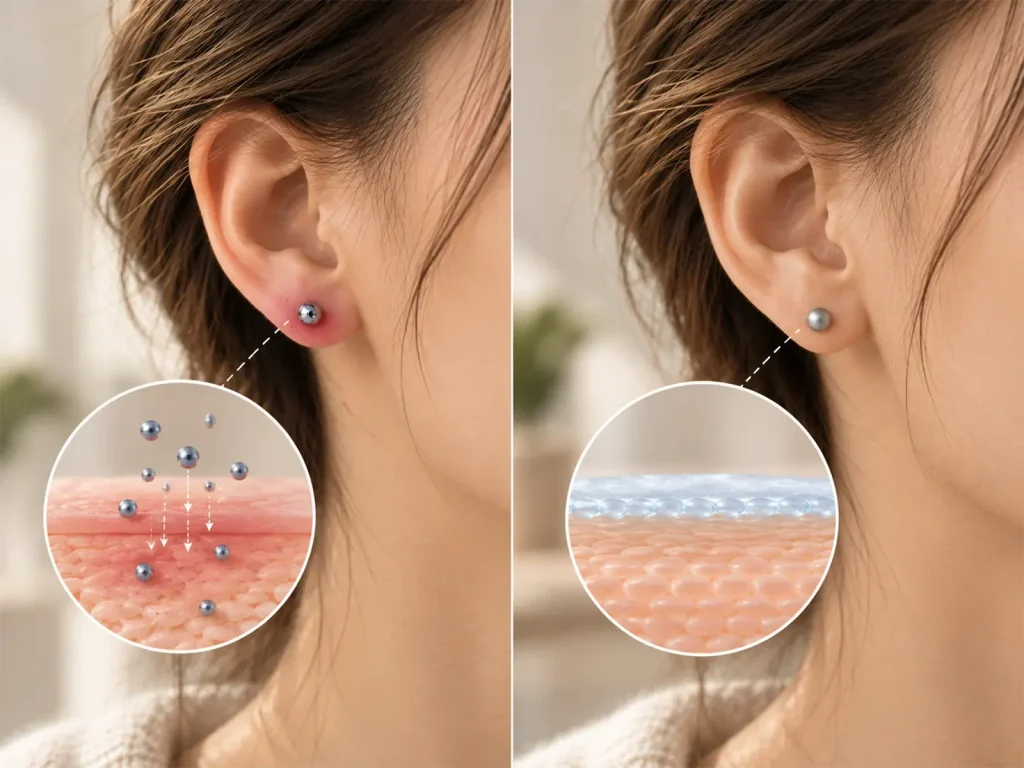
When microscopic nickel ions are released from a metal surface, they can bind to proteins in the skin.
For some people, the immune system sees this new combination and mistakenly treats it as a threat.
The body responds by activating immune cells.
That response can lead to:
• Itching
• Redness
• Swelling
• Dry or flaky skin
• Burning sensations
This condition is commonly known as allergic contact dermatitis.
In other words, the discomfort isn’t caused by the nickel attacking your skin.
It’s caused by your immune system trying to protect you from something it believes shouldn’t be there.
Why Can Someone Become Allergic Later In Life?
One of the most confusing aspects of nickel allergy is that it often develops gradually.
Many people say:
“I’ve worn jewelry for years. Why am I suddenly allergic now?”
The reason is that allergies are often built through repeated exposure.
The first contact may not cause any reaction.
The tenth may not either.
But over time, the immune system can become increasingly sensitive.
Eventually, it begins recognizing nickel as something worth defending against.
Once that happens, even small amounts of exposure may trigger symptoms.
This is why nickel allergy can seem to appear out of nowhere.
In reality, the process may have been developing for years.
Why Titanium Usually Behaves Differently
If nickel is known for causing allergies, titanium is known for the opposite.
Professional piercers often recommend implant-grade titanium for new piercings.
Medical implants frequently use titanium alloys.
But why?
The answer is not that titanium is somehow “magic.”
The answer is stability.
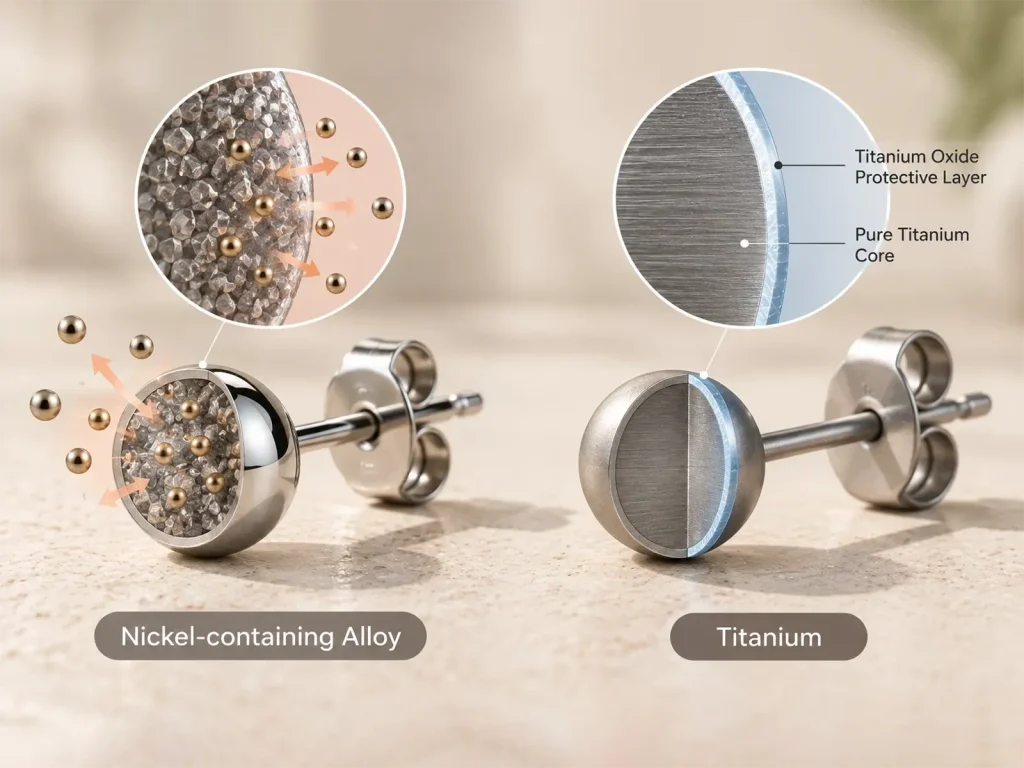
When titanium is exposed to air, it naturally forms an extremely thin layer of titanium dioxide (TiO₂).
You can’t see it.
You can’t feel it.
But it plays a critical role.
Think of it as an invisible protective shield covering the metal.
This protective layer helps separate the metal beneath from the surrounding environment.
As a result, titanium releases very few metal ions compared with many other materials.
Fewer ions reaching the skin generally means fewer opportunities for the immune system to react.
This is one reason titanium has earned a reputation as one of the most skin-friendly materials used in jewelry.
Why Do Piercers Prefer Titanium For Fresh Piercings?
A healed piercing and a fresh piercing are completely different situations.
A healed piercing already has stable tissue.
A fresh piercing is essentially a small wound that is still recovering.
During healing, the body is more sensitive to irritation and inflammation.
This is why many professional piercers choose implant-grade titanium.
Not because it looks better.
Not because it is more fashionable.
But because reducing unnecessary irritation gives the body the best environment for healing.
Once a piercing has fully healed, many people can comfortably wear a wider range of materials.
But during healing, stability matters.
And titanium is exceptionally stable.
What About 316L Stainless Steel?
This is where things become more nuanced.
Many people assume 316L stainless steel contains no nickel.
That is not true.
In fact, 316L stainless steel does contain nickel as part of its alloy composition.
So why do so many people wear it comfortably?
The answer lies in how the alloy is structured.
In high-quality 316L stainless steel, the nickel is bound within the metal matrix and protected by a corrosion-resistant surface layer.
For most people, the amount released during everyday wear is extremely low.
As a result, 316L remains one of the most widely used materials in jewelry, watches, and medical instruments.
If you want to learn more about stainless steel safety, check out our guide on Is 316L Stainless Steel Safe for Daily Jewelry Wear?
However, people with an established nickel allergy may still experience reactions.
This is why titanium is often preferred for highly sensitive individuals, while 316L works perfectly well for the majority of wearers.
Neither material is universally better.
The right choice depends on the individual.
Why Surface Finishing Matters More Than Many People Think
Material is only part of the story.
Surface finishing also affects how jewelry interacts with the skin.
A poorly finished surface can trap dirt, moisture, and bacteria more easily.
Rough edges can create additional friction.
Tiny imperfections can increase irritation during long-term wear.
This is one reason two pieces made from the same metal can feel completely different in practice.
Good jewelry is not only about choosing the right material.
It is also about how that material is finished and refined.
Sometimes comfort comes from details that are nearly invisible.
How to Choose the Right Alternatives to Nickel Allergy Jewelry?
If your skin reacts easily, consider focusing on a few practical factors:
• Implant-grade titanium for maximum skin compatibility
• High-quality 316L stainless steel from reputable manufacturers
• Smooth, well-finished surfaces
• Proper sizing and fit
• Good cleaning habits
Most importantly, don’t assume every irritation is an allergy.
And don’t assume every metal will affect you the same way.
Skin is personal.
The material that works perfectly for one person may not be ideal for another.
A Luveriko Perspective
At Luveriko, we believe comfort begins with understanding.
The name of a material matters.
But the full story includes design, finishing, craftsmanship, and how a piece interacts with everyday life.
Because jewelry is meant to be worn, not just admired.
The best pieces are often the ones you stop noticing altogether.
Not because they lack character.
But because they fit so naturally into your daily routine.
And for many people, that comfort begins with choosing materials that work in harmony with their skin.
Metal allergies are not always about the metal itself.
They are often about how the body responds to it.
And understanding that difference can make choosing jewelry much easier.