

If you’re considering titanium jewelry, you’ve probably asked a common question:
Does titanium jewelry scratch easily?
It’s a reasonable concern.
Many people associate titanium with exceptional strength.
After all, titanium is used in aerospace engineering, medical implants, and high-performance equipment.
So when small marks eventually appear on a titanium ring or bracelet, it can feel surprising.
The reality is more nuanced.
Titanium is highly durable, but durability and scratch resistance are not exactly the same thing.
Understanding that difference helps set realistic expectations and explains why titanium remains one of the most popular materials for everyday jewelry.
Strength And Scratch Resistance Are Not The Same Thing
One of the biggest misconceptions about titanium jewelry is the belief that a strong material cannot scratch.
In reality, strength and scratch resistance measure different things.
Strength refers to a material’s ability to resist bending, breaking, or deforming under force.
Scratch resistance refers to how easily the surface can be marked by contact with another material.
Titanium performs exceptionally well when it comes to strength.
It is lightweight, corrosion-resistant, and highly durable.
However, that does not mean its surface is immune to everyday wear.
Even highly durable materials can develop small scratches over time.
Why Titanium Jewelry Develops Scratches
Most scratches do not come from dramatic accidents.
They come from ordinary life.
A ring touches a desk while typing.
A bracelet brushes against a zipper.
A pendant rubs against keys inside a pocket.
These small interactions happen repeatedly.
Over weeks, months, and years, they gradually leave subtle marks on the surface.
For many people, the surprise is not that scratches appear.
The surprise is how ordinary the causes are.
Do Scratches Mean The Jewelry Is Damaged?
Not necessarily.
In most cases, scratches affect only the surface.
The structure of the jewelry remains unchanged.
The piece is still performing exactly as intended.
This is particularly true for titanium.
One of titanium’s greatest advantages is its ability to maintain structural integrity even after years of wear.
A scratched titanium ring is usually still a very strong ring.
The appearance may change.
The material itself generally does not.
Why Some Titanium Jewelry Shows Scratches More Clearly
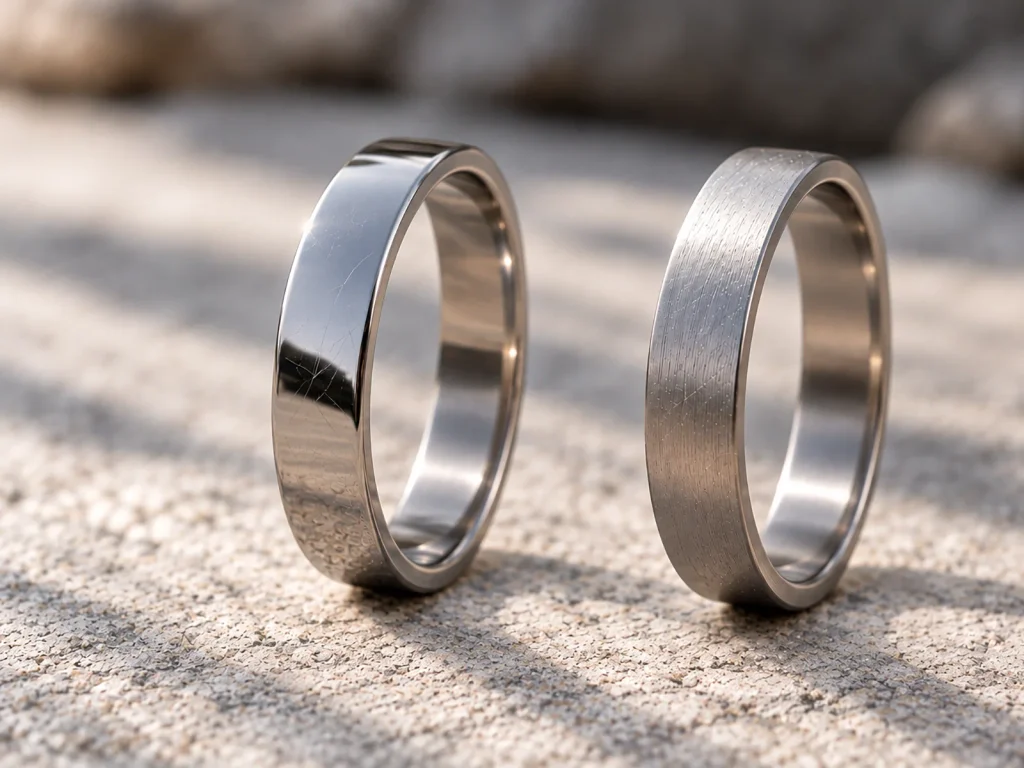
The finish of a piece often matters more than the material itself.
Highly polished titanium reflects light evenly.
As a result, small scratches can become more noticeable because they interrupt that reflection.
Brushed finishes behave differently.
The surface already contains fine directional textures.
Minor scratches tend to blend into the existing pattern.
This is one reason many people who wear jewelry every day prefer brushed titanium finishes.
The jewelry experiences wear either way.
The difference is simply how visible that wear becomes.
Titanium Vs Stainless Steel: Which Looks Better Over Time?
When people compare titanium and stainless steel, they often focus on strength.
But everyday wear tells a slightly different story.
Titanium is exceptionally strong for its weight.
However, both titanium and 316L stainless steel can develop small surface scratches through daily use.
The difference is often visual rather than structural.
Titanium tends to develop a softer, more understated appearance over time, especially with brushed finishes.
Stainless steel often maintains a brighter and more reflective look.
Neither aging pattern is better.
They simply create different visual experiences.
Some people prefer the cleaner appearance of polished stainless steel.
Others appreciate the subtle character that gradually develops on titanium through years of wear.
What Daily Wear Really Looks Like After A Year
Many people imagine scratches as major flaws.
The reality is usually much less dramatic.
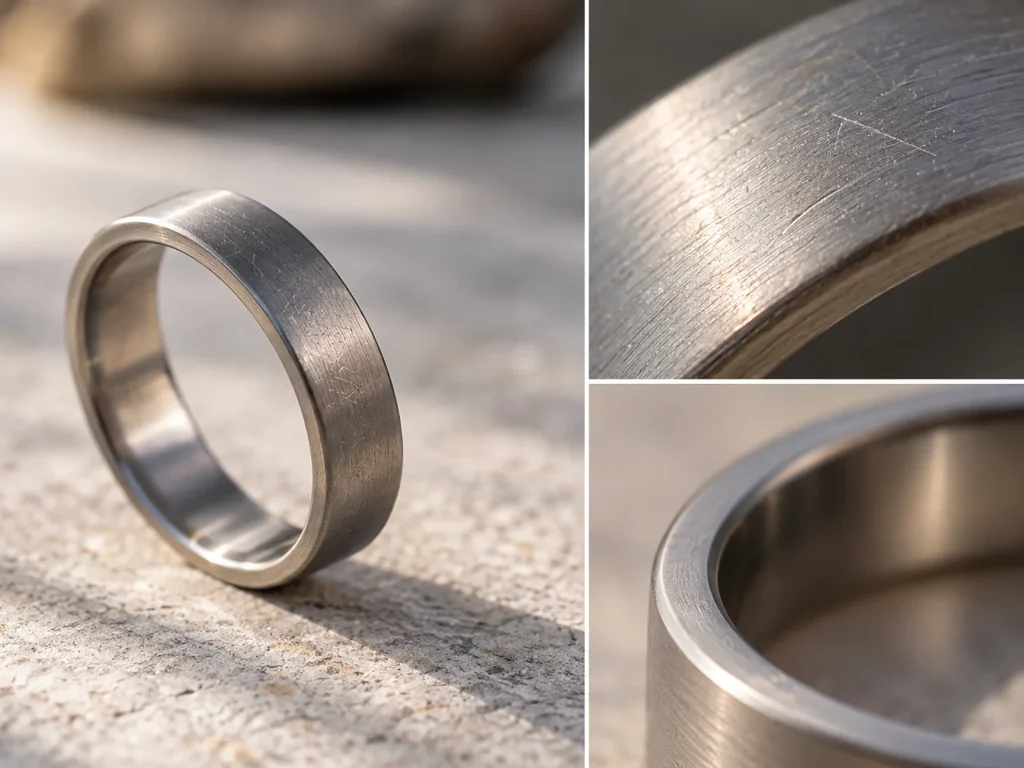
After a year of everyday wear, most titanium jewelry develops tiny surface marks that are visible only under certain lighting conditions.
Rather than appearing damaged, the piece often looks slightly more lived-in.
The sharp perfection of a brand-new surface softens.
Reflections become less uniform.
The jewelry begins to reflect its history of use.
Some people dislike this.
Others find it appealing.
It largely depends on personal preference.
Can Titanium Jewelry Be Restored?
Light surface scratches can often be improved through professional refinishing.
The exact process depends on the finish.
Polished surfaces may be re-polished.
Brushed surfaces can often be refreshed by recreating the original texture.
However, many long-term jewelry wearers choose not to remove every mark.
Over time, these signs of wear become part of the character of the piece.
The goal is not always to erase history.
Sometimes it is simply to care for it.
Should Scratches Stop You From Choosing Titanium?
For most people, the answer is no.
Titanium remains one of the best materials for everyday jewelry.
It is lightweight.
Comfortable to wear.
Highly resistant to corrosion.
Suitable for long-term use.
And despite developing normal surface wear over time, it maintains its structural strength remarkably well.
The question is not whether titanium jewelry will scratch.
Almost all jewelry eventually does.
The more useful question is whether the material continues to perform well after years of daily life.
Titanium generally does.
Frequently Asked Questions
Does Titanium Jewelry Scratch Easily?
Titanium jewelry can develop small surface scratches through normal daily wear.
However, these scratches are usually cosmetic and do not affect the structural strength of the jewelry.
Is Titanium More Scratch-Resistant Than Stainless Steel?
Both titanium and 316L stainless steel are durable materials.
In everyday use, the difference is often less significant than people expect.
Surface finish usually has a greater impact on how visible scratches appear.
Do Brushed Titanium Rings Hide Scratches Better?
Yes.
Brushed finishes generally conceal minor scratches more effectively than highly polished surfaces because the texture diffuses light and reduces visible reflections.
A Luveriko Perspective
At Luveriko, we believe jewelry is meant to be worn rather than preserved in perfect condition.
Surface wear is a normal part of ownership.
What matters is not whether marks appear, but how a material responds to years of use.
Good everyday jewelry should remain comfortable, durable, and visually appealing even as it gradually develops signs of wear.
Because long-term satisfaction comes not from perfection, but from consistency.
Titanium jewelry is highly durable,
but durability and scratch resistance are not the same thing.
The real measure of a material is not whether it changes, but how well it continues to perform as it does.